
Liquid creamers
Lecithin is added with the oil phase before homogenisation, where the interface is created.
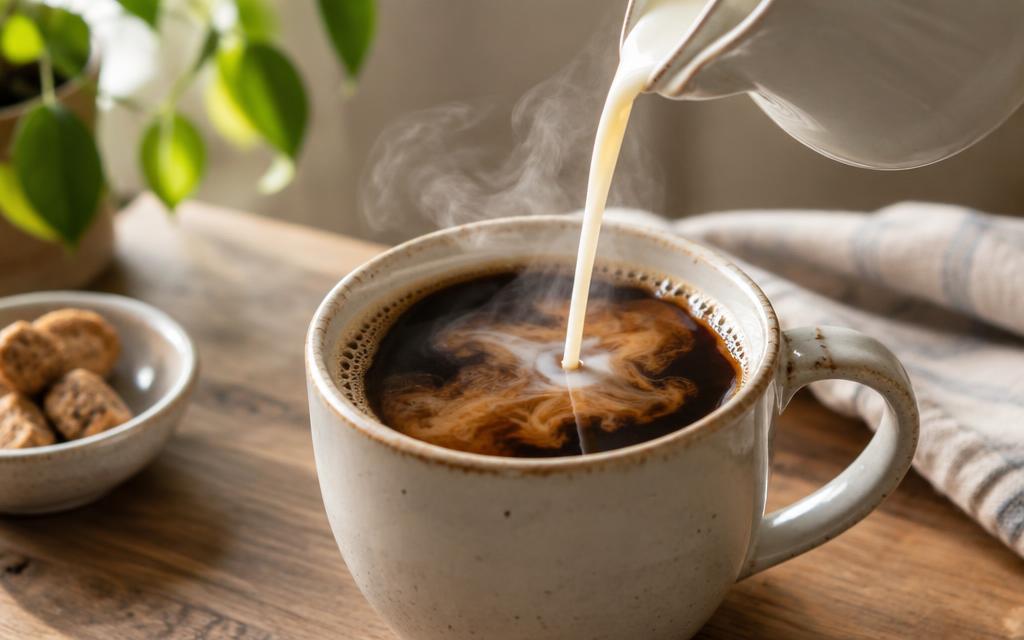
Barista & dairy-free creamers
Supports emulsification and powder wetting in creamer systems, with guidance matched to how your creamer is processed.
Manufacturing problem
Creamers carry a high fat load in a small serving and meet hot, acidic coffee at the moment of use. Emulsification — and, for powdered creamers, wetting — decides how the product behaves from the cup to the pack.
What lecithin changes
In liquid creamers, sunflower lecithin positions at the oil-water interface during emulsification. In powdered creamers, de-oiled powder supports how the finished mix wets and disperses when it is prepared.
Practical process roles, not a one-size-fits-all formulation claim.
Lecithin is added with the oil phase before homogenisation, where the interface is created.
De-oiled powder is dry-blended to support wetting when the mix is prepared.
Reviewed against the preparation conditions the product will meet at the café.
This starting-point map helps your team choose a trial path. Exact guidance follows review of your process.
| Application | Format | Addition stage | Target effect |
|---|---|---|---|
| Liquid creamer | Liquid | With the oil phase before homogenisation | Emulsification at the interface |
| Powdered creamer | Powder | Dry-blended with the finished mix | Wetting and dispersion on preparation |
| Concentrated creamer base | Liquid | Into the oil phase during preparation | Even oil distribution in the concentrate |
| Dairy-free creamer premix | Powder | Dry-blended before packing | Free-flowing, repeatable dosing |
No formulation percentages are published here. Share your process for application-specific trial guidance.
Choose a format to see guidance written for this manufacturing process.
Blend with the dry mix so wetting behaviour is built into the finished powder.
Store in the original packaging at room temperature (16-32°C / 61-90°F), away from direct sunlight, moisture, and air.
Humidity and blend order affect how the finished powder behaves; validate with the actual blend.
Powder grade produced at a GMP+ and FSSC 22000 certified facility.
Lot-specific certificates of analysis, spec sheets, and certification documents are available on request.
Tell us whether the creamer is liquid or powder, the fat system and the volume you run. We will respond with pricing and a sample.